What is Pilates?
Pilates is an exercise method based on strengthening the core of the trunk, moving with control and matching movement to the breath.
At the heart of the method is a simple idea: movement starts from the core of the body. When the muscles around the abdomen, back and hips work together, the arms and legs move more easily and with better balance. That is why, in Pilates, how a movement is performed comes before speed and the number of repetitions.
At ATC we treat Pilates not as a stand-alone “class” but as part of training for life. It matters to us that the sense of control you gain in the studio stays with you when you are sitting at a desk, lifting something or walking.
Movement at its most controlled.
The core principles of Pilates
Whatever your level, you will meet the same principles in every class. They help you get to know your body rather than memorise movements.
Core
Movement is initiated from the core of the trunk; the arms and legs build on that support.
Control
Every movement is done consciously. Attention comes first, not swinging or momentum.
Breath
The breath accompanies the movement; it sets the rhythm and makes it easier to focus.
Balance
The right and left sides of the body, and the front and back muscle groups, are worked together.
Alignment
Attention is paid to the position of the spine, shoulders and hips.
Flow
Movements link into one another; the class progresses as a whole.
Who is it suitable for?
Pilates is a method that can be adapted to different ages and fitness levels. If any of the following sounds familiar, it may be a good starting point:
You do not need any previous experience. Our programmes are planned around different levels of experience and fitness; the first classes concentrate on basic movements and breathing.
- You have never exercised before and are looking for a controlled start.
- You sit for long periods during the day and want to pay more attention to your posture.
- You do another sport and want to support your core and your balance.
- You are drawn to focused, calm work more than to fast-paced training.
- You want to know your body better and improve how you move.
How does a Pilates class run?
The content of classes varies with level and goal; the general flow, however, is usually similar:
Our aim is for you to leave the class feeling tired but gathered, not scattered. How one hour of training carries into your movement all day matters to us as much as the class itself.
Preparation and breath
The class begins with gentle movements that warm up the body and with breathing work. The aim is to turn your attention from the pace of the day to your body.
Core work
Basic movements are performed that work the abdomen, back and hip area together. Your trainer watches your posture and corrects it where needed.
Whole body
The arms, legs and spinal mobility are brought into the work. Movements are made easier or harder according to your level.
Stretching and close
The class ends with stretches that ease the areas you have worked.
Mat and equipment Pilates
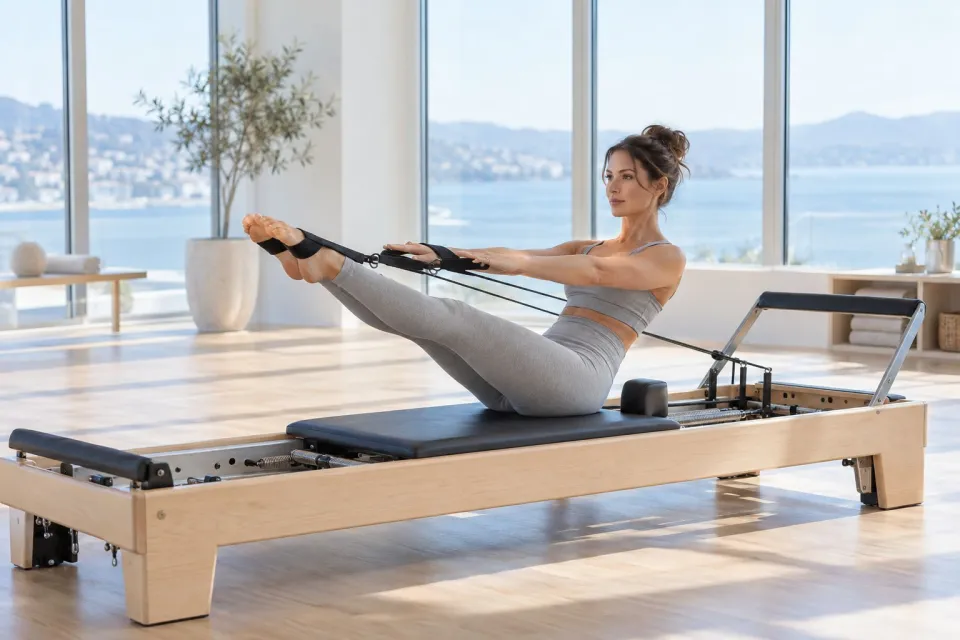
Pilates is generally practised in two forms. In mat Pilates, movements are done on a floor mat, mostly with body weight; small pieces of supporting equipment may be used. In equipment Pilates, apparatus with spring systems, such as the reformer, comes into play. Because the springs can provide both resistance and support, the same movement can be adapted to different levels.
Both forms rest on the same principles; which one suits you depends on your goal, your experience and your preference.
One-to-one and group options
Depending on the discipline, there are options to work one-to-one or in a group. In one-to-one classes the programme is built entirely around you and the trainer’s attention is on you alone throughout; this can be a comfortable start for those learning the movements for the first time. In group classes, the rhythm of working together and the discipline of a regular class time come to the fore.
We can decide together which model suits you, based on your goals and preferences. For a detailed comparison, take a look at the Disciplines page.
What makes Pilates at ATC different?
Pilates classes, too, are part of ATC’s overall approach. Before you start, we carry out a short initial assessment; we learn about your training history, your goals and the points that need attention. Your progress is tracked throughout, and the programme is updated accordingly.
You can find the details of this structure on the Our Approach page.
- A trainer who knows you: You work with someone who knows your goals and adapts the movements to you.
- A process you can track: With our technology infrastructure and trainer assessments, we aim to make your progress as visible as possible.
- A link to the other disciplines: The core control you gain in Pilates can also support your fitness and yoga work.
How does Pilates carry into daily life?
The slogan “Know your body. Improve how you move.” sums up what Pilates means outside the studio. What you learn in class is less about particular movements and more an awareness of how you use your body. That awareness can show itself in everyday moments:
These look like small details; yet they are movements repeated hundreds of times a day. This is exactly where Pilates sits in the “training for life” approach: carrying control with you not only in class but through the rest of the day.
- Noticing, while sitting at your desk, that your shoulders have risen or your lower back has slumped.
- Paying attention to how you use your trunk when lifting something off the floor.
- Spreading your weight evenly over both feet when standing and waiting.
- Taking more controlled steps when walking or climbing stairs.
Common mistakes beginners make
The points below are things almost everyone runs into in the first few weeks. Your trainer already watches for them in class; even so, knowing them in advance makes things easier.
- Holding your breath: Holding your breath when something is hard is a natural reflex. In classes, how the breath is matched to the movement is taught step by step.
- Going fast: Finishing a movement quickly makes it easier; but in Pilates the aim is the exact opposite. Slow, controlled repetition demands more attention.
- Loading the neck and shoulders: When the core tires, the load can shift to the neck and shoulders. At such moments, making the movement easier is better than pushing on.
- Comparing yourself with others: The option the person next to you is doing may not be right for you. Everyone works with the option at their own level.
Common misconceptions about Pilates
“Pilates is only for women.”
The method rests on principles that anyone can work with, regardless of gender. Core strength, balance and control are the foundation of your movement, whoever you are.
“Pilates is easy, light exercise.”
Moving at a calm rhythm does not mean it is easy. A slow movement done with control can be more demanding than many repetitions done quickly. The level of difficulty is set according to your level.
“Pilates and yoga are the same thing.”
Although both rest on attentive work in harmony with the breath, their focus differs. Pilates gives more weight to the core and to stability, while yoga gives more to postures, stretching and flow. They can be thought of not as substitutes for each other but as complementing each other.
Preparing for your first class
You do not need any special preparation for your first class. A few small suggestions will make things easier:
- Choose comfortable, close-fitting clothes that do not restrict movement; it is important that your trainer can see your posture.
- Avoid eating a heavy meal just before class.
- Bring water with you.
- If you have a complaint, or anything you would like taken into account that day, tell your trainer before the class begins.
Frequently asked questions about Pilates
Do I need to be flexible to start Pilates?
No. Flexibility is not a prerequisite; it is something that can develop over time. Movements are adapted to your current range of motion.
How many days a week should I do Pilates?
That depends on your goal, your current fitness and your daily life. Our trainers help you set up a routine that is sustainable for you.
Is Pilates enough on its own?
It depends on your goal. Some members do Pilates only; others continue it alongside fitness or yoga. We can talk this through together in your initial assessment.
Can I take a trial class?
You can find out about our current trial class and introductory meeting options through our contact form or on WhatsApp.